CRITICAL ACCLAIM
“The 2021 Agreement on Global Corporate Tax was unambiguously a milestone in the ongoing fight against tax havens and all ensuing negative external effects. The author has managed to put together an authoritative account of the workings of this remarkable achievement, the process that led to it, and its consequences. It is a must-read volume for academics and practitioners alike.”
– Petros C Mavroidis, Edwin B. Parker Professor of Foreign & Comparative Law, COLUMBIA LAW SCHOOL
“This book is an outstanding study of how the remarkable 2021 agreement on the global corporate tax was reached and signed by over 140 countries. It should be read by anyone who is interested in the possibility of reaching multilateral solutions to global problems, not just tax experts.”
– Reuven S. Avi-Yonah, Irwin I. Cohn Professor of Law at the UNIVERSITY OF MICHIGAN
“Motala’s book demonstrates how systemic shocks, expert networks anchored in the OECD, and distributional conflicts among States combined to alter the foundations of international corporate taxation. The analysis advances a ‘dynamic’ model of global corporate tax governance that explains both the evolutionary adjustments of the past decade and the potentially revolutionary character of the 2021 agreement. This model provides a coherent account of how crises trigger delegation to technical experts, how transnational epistemic communities construct new norms, and how bargaining among major powers and domestic political constraints determine the scope of implementation. This monograph stands out for offering not merely a historical record but an explanatory framework that will inform future scholarship on international economic law and multilateral governance.”
– Julien Chaisse, Professor & RGC Senior Research Fellow, School of Law, CITY UNIVERSITY OF HONG KONG
NEW BOOK RELESASE | APRIL 6, 2026
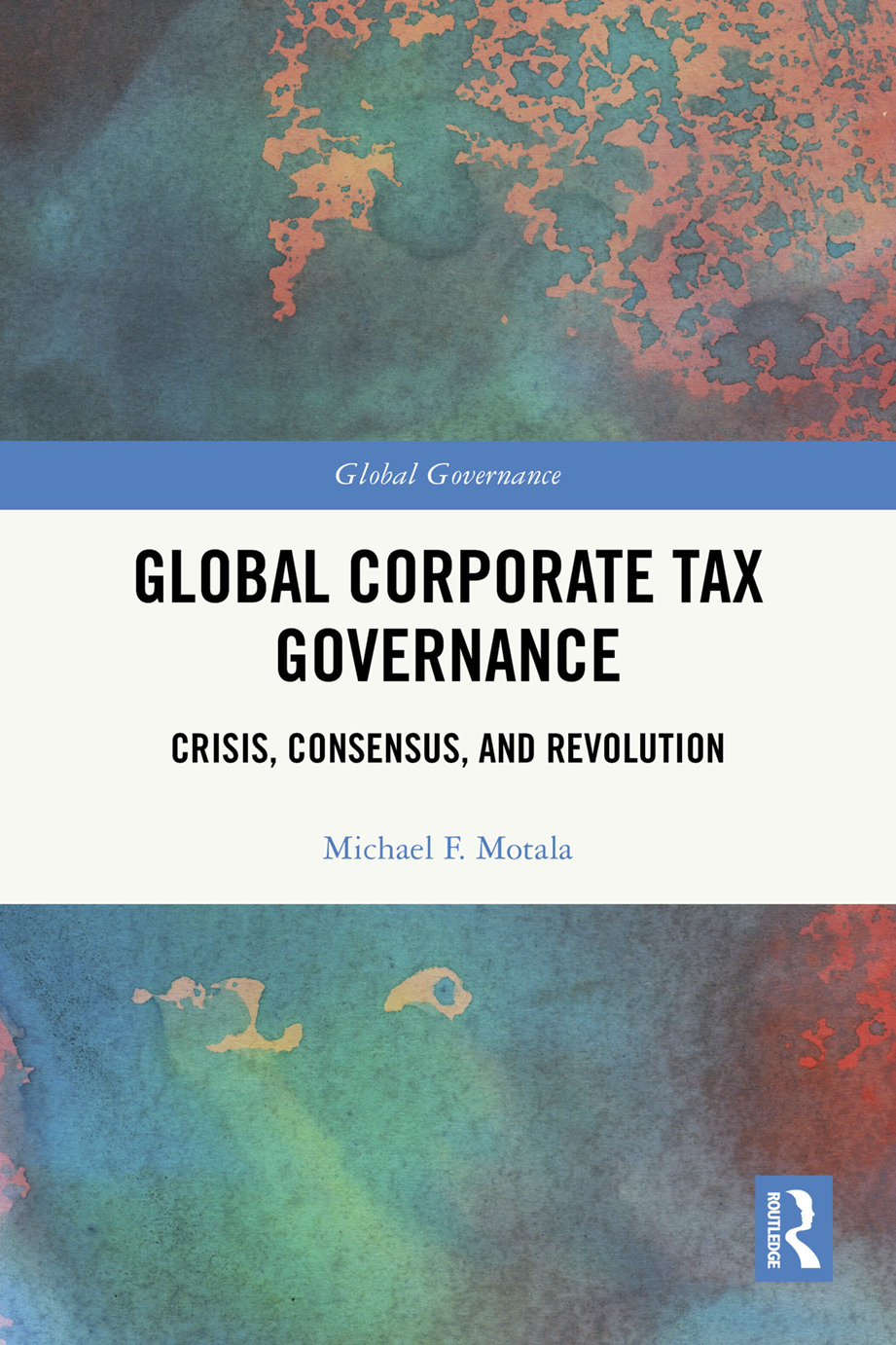
Global Corporate Tax Governance: Crisis, Consensus, Revolution
By MICHAEL MOTALA
Routledge (London) | 1st Edition | 290 Pages | April 2026 | ISBN: 9781003508519
This book examines the transformative changes in international corporate taxation from 2008 to 2021, culminating in the landmark October 2021 Agreement that reshaped how multinational businesses are taxed worldwide. Drawing on empirical, comparative, and meta-historical analysis, it reveals the decisive role of the Transnational Tax Policy Community as agenda-setter, adviser, and gatekeeper in the G-20 and OECD reform process—while demonstrating that domestic politics substantially shape implementation outcomes. The work introduces a Dynamic Model of Corporate Tax Governance that explains the revolutionary adoption of the two-pillar framework and 15% global minimum tax, and predicts future developments in the ongoing tension between multilateral cooperation and state sovereignty.

Michael Motala, Ph.D., J.D., is an Assistant Professor of Law and Political Science at the University Tulsa College of Law, the Director (Taxation) of the G20 Research Group at the University of Toronto's Munk School of Global Affairs, and an Instructor in Taxation and Osgoode Hall Law School, York University. Professor Motala is interdisciplinary legal scholar and political scientist with expertise on the law and global governance of international corporate taxation and the tax planning strategies employed by multinational corporations. He focuses on the intersection of law and political economy, and his research and writing focuses on international economic law, law and economics, and business law. Motala has previously conducted research or taught at Osgoode Hall Law School, Columbia Law School, Stanford Law School and the University of Toronto’s Trinity College, and holds five degrees and multiple certifications spanning institutions in the United States of America, Canada, the United Kingdom and France.